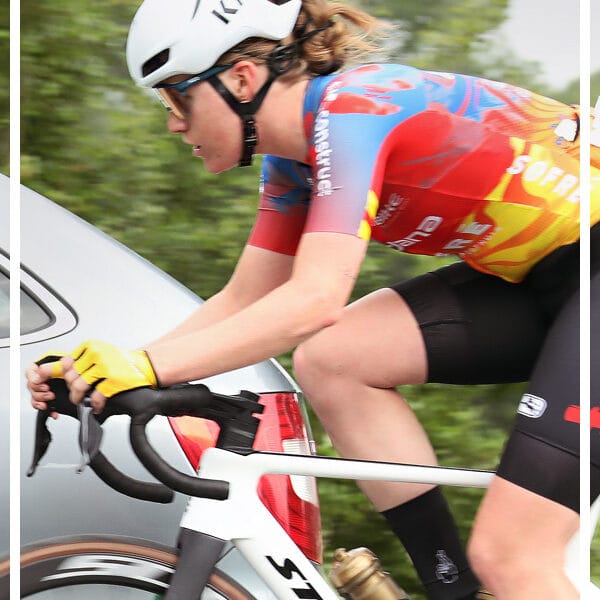
 Sander Steins
From tandem club rides in Norfolk (UK) -powered by adventure and the promise of cake- to racing across Europe and beyond, Henrietta Colborne’s professional journey in cycling has always been driven by people, curiosity, and a willingness to embrace the unknown. Now preparing for the 2026 season with XDS China Women Cycling Team, she enters a new chapter that stretches far beyond familiar European roads.
Balancing life in the international peloton with her work as Director and Coach at The Bike Inn, Colborne brings both lived racing experience and technical expertise to everything she does. In this interview, she reflects on independence, resilience, global racing, and why sometimes you have to be the nail before you can become the hammer.
Early career
The club that built a racer
You started racing in youth clubs like Border City Wheelers and Beacon Wheelers. What first drew you into cycling, and did you always know you wanted to pursue it professionally? How has your identity as a rider evolved over the years?
I actually got into cycling at eight years old… I was pulled onto the back of a tandem and taken out on Sunday club runs in Norfolk. And honestly, it’s completely true what they say: it’s the people in a club that matter most.
At eight years old, riding 50 miles felt like a huge adventure. We’d finish at a club member’s house for tea, I’d always get the biggest slice of cake, and then still have a seven-mile ride home. That was more than enough motivation for me… especially because the cake was always excellent!
At the same time, my dad was racing cyclo-cross with the club (Fat Birds Don’t Fly), so I naturally tagged along and did the youth races. That’s when I realised cycling wasn’t just something you did on a Sunday… it was fun, it was competitive, and it was something I wanted to get better at.
When we later moved “up north”, I joined Border City Wheelers and Beacon Wheelers. Again, it was the people that made the difference… the coaching, the lifts to races, the encouragement. Without the Fat Birds Don’t Fly Club, the McLeans, and of course my dad, I wouldn’t still be cycling today.
Looking back, one thing my dad did brilliantly was not being a pushy parent. If I wanted to race at 13, I had to organise it. Book the hotel. Work out the travel time. Enter the race. Plan the month. He’d drive me there, but then often “abandon” me and go walk the dogs!
Why am I telling you this? Because in hindsight, it was the best thing he could have done for me. It meant that at 16, travelling alone to races in Europe was not an issue. It taught me independence in a safe environment.
How would you describe yourself as a rider today, and how has that changed with experience?
I’d say I’m an experienced and aggressive rider now. I like racing hard and getting involved… last year I managed some strong breakaways.
But the biggest thing I’ve learned is that you race best when you’re enjoying it. Of course fitness matters… it’s much nicer to be the hammer than the nail! But you also have to remember in order to be a hammer you have to be a nail first! That’s part of the process.
What have you learned from racing in different teams and countries?
Honestly? Rock and roll! When going into a new environment embrace it.
Every team and every country has its own culture, humour, and way of doing things. If you go in open-minded and curious, you’ll connect with people so much more easily.
On a practical level, when traveling or racing so many things can happen, if something goes wrong… stressing is simply pointless.
A few practical tips:
- Having a bank account that lets you easily change currency (like Wise).
- Keeping digital copies of your passport and documents.
- If traveling regularly, Airtags are a godsend.

2026 & XDS
A golden opportunity
You’ll be racing for XDS China Women Cycling Team in 2026. How did that come about?
In very late December, my previous team announced they wouldn’t be continuing at continental level. That’s not the ideal time to be looking for a ride… by December, most teams are already full. I knew I was basically hunting for “dead man’s shoes.”
But sometimes timing works out. I got in contact with Tim Harris and Simon Cope, (Director Sportivies). After speaking with them and hearing their vision for the team, I was 110% committed.
As a European rider, it’s very easy to stay within the European circuit. But when an opportunity comes up to race further afield, experience different styles of racing and see new parts of the world… why wouldn’t you? It felt like being handed a golden ticket.
Are there specific races you’re targeting?
We’ve got a really mixed calendar… everything from Belgian kermesses in the summer to UCI races in the Czech Republic.
The Czech races are definitely ones I’m targeting. I’ve historically gone well there, so I’m excited to head back and build on that.
Has your mindset changed going into this season?
Definitely.
When you’re younger, you can become obsessed with always being “on form.” You want to feel amazing at training camp, amazing in every race. But that’s not how it works.
Yes, you need to be fit and you need to peak at the right times. But you can sometimes have some of the worst legs in the peloton and still have a good race… if you’re smart. If you attack at the right time, follow the right wheels, position well.
That said… some days you just need the power!
Training Philosophy
Experience over obsession
Training philosophies evolve over time. What are you prioritising most in your training now… and why?
Experience teaches you a lot. You learn what works for your body and what doesn’t. It probably helps that I’m also a cycle coach.
But to a certain extent, the old adage is true: to be good at racing, just go and race. Sometimes this means you don’t train very specific efforts (e.g., 20–30 minute climbing efforts), but it builds race instinct, speed, and bike handling.
So I would say it’s about balance… structured training combined with real race days.
Women’s cycling continues to grow and professionalise. What progress excites you most right now?
Exposure is key to women’s cycling… social media and TV coverage are huge. The growth of the sport, with teams becoming more professional and governing bodies tightening regulations, is pushing everything forward.
However, the movement must not be too fast for smaller teams to keep up. Over the past few years, a number of small continental teams have been unable to meet the demands of new rules and have had to stop. This reduces development opportunities for riders.
Bike fit & performance
Precision matters
You’re Director and Coach at The Bike Inn. How does your lived experience as a professional rider shape the way you approach bike fitting?
Having ridden a bike since I was nine years old -and having suffered a disc hernia two years ago- you truly understand how important a properly fitting bike is.
So many people try to make themselves fit the bike. Bike fitting is a continuous process. Someone might have lost weight, picked up an injury, or become less flexible with age.
A common mistake is assuming that because you had a bike fit five years ago, those measurements will always apply. That simply isn’t the case.
What’s the most common issue you see?
Saddle choice and saddle height.
If you’re not comfortable on the saddle, you’re not going to enjoy riding… and you’re definitely not going to perform well. Small changes there can make a huge difference.

Life beyond results
Balance in a demanding sport
With racing, training, and professional responsibilities, how do you maintain balance and avoid burnout?
There are 48 hours in a day, right?
No, in all seriousness, sometimes it is a juggling act. You have to prioritise the essentials. What needs to be done now? Can I manage this alone, or do I need help?
Being realistic about what you can achieve helps prevent burnout… as does avoiding the trap of trying to please everyone and doing everything at an average standard.
At the moment doing this interview, we are in Sri Lanka delivering a Level 2 Cycle Mechanic course at Lumala. This project is particularly interesting as we are working with deaf participants, which adds the challenge of language and communication.
With projects like this, you can make a real impact. For many people, the bicycle is a sustainable and essential mode of transport.
Describe your perfect ride day.
An epic, long ride… something that really challenges you.
Cumbria (UK) in the summer is hard to beat. Big views, quiet roads, proper climbing.
But Mallorca and the hill country in Sri Lanka have also given me some of the most stunning ride days I’ve ever had. Good terrain, good company, and just enough suffering to make it memorable… that’s perfect.
Photos: Henrietta Colborne/Sander Steins