 Sander Steins
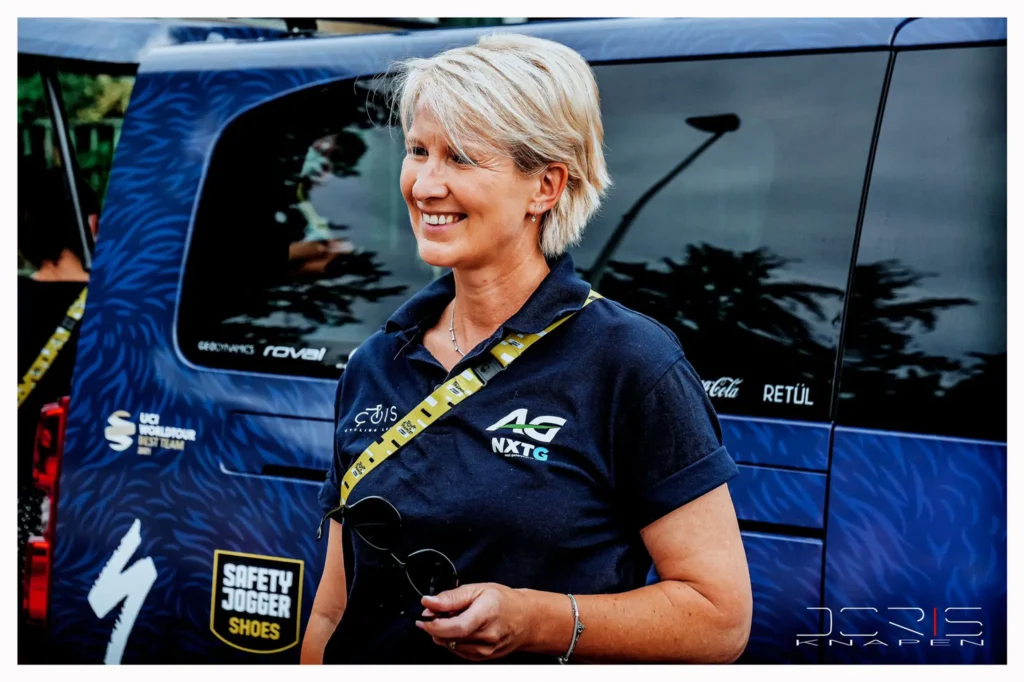
Natascha den Ouden (Galder, 1973) knows women’s cycling from virtually every possible angle. As a rider, she was a four-time Dutch cyclocross champion and won silver at the Junior Track Cycling World Championships in Moscow in 1989. After her active career, she worked for years as a physiotherapist, became co-founder and team manager of AG insurance-Soudal, and dedicated herself to developing young female cycling talent. Recently, she also started her own agency, Right Match, through which she supports riders in finding the right environment to develop both sportingly and personally.
Thanks to her experience as a former top athlete, healthcare professional, team manager, and talent developer, Den Ouden looks at the current state of women’s cycling with a broad perspective. While many primarily see the visible growth of the sport, she has been worrying for years about what is happening beneath the surface.
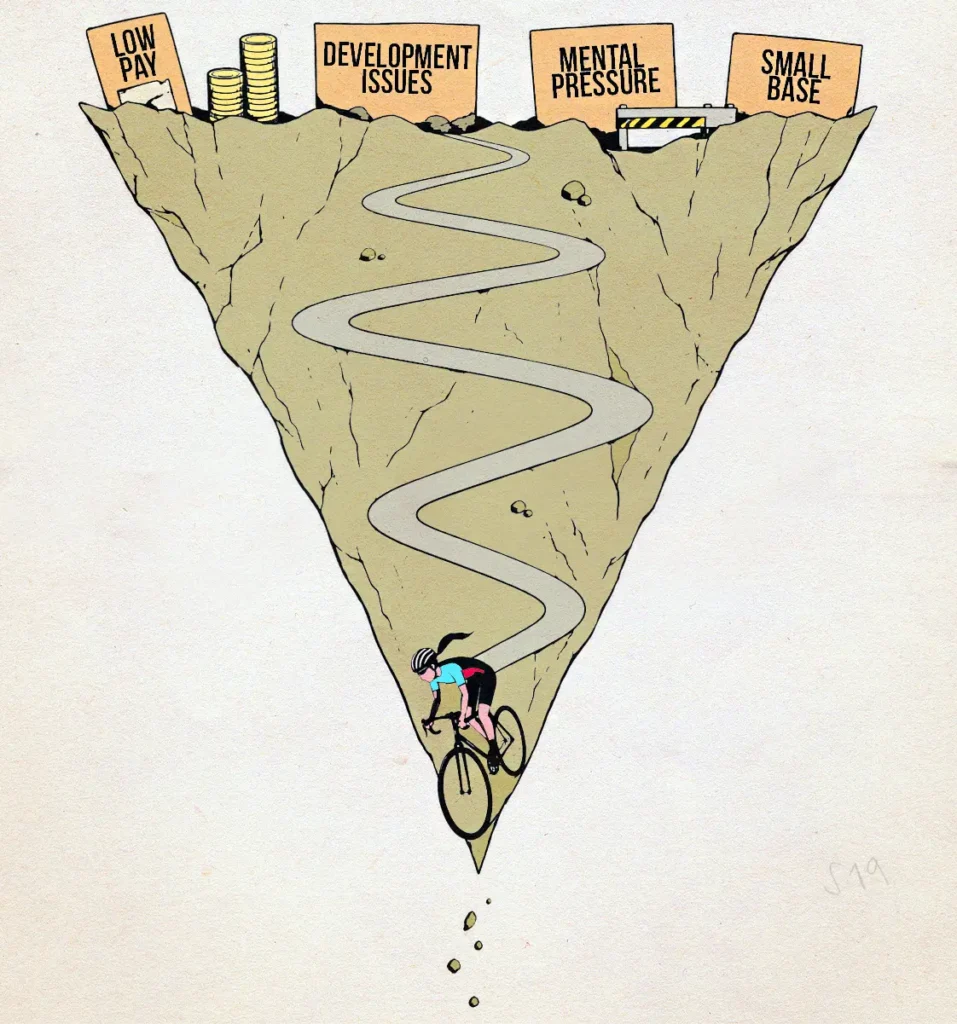
According to Den Ouden, women’s cycling is currently growing faster at the top than at the base. The WorldTour is getting bigger, salaries are rising, and attention is increasing. But at the same time, continental teams are disappearing, the development layer below the top is becoming ever narrower, and organizers and sponsors are coming under pressure.
In her eyes, the sport is therefore in danger of making the same mistake you see in many organizations when success grows faster than the structure meant to support it.
“You don’t build a house by starting with the roof.”
The sport is growing. But is the base growing with it?
Everyone has seen the explosive growth of women’s cycling in recent years. The Tour de France Femmes attracts plenty of attention. New WorldTour races are constantly appearing on the calendar. Big sponsors are jumping in. Salaries are rising. For the first time, women’s cycling seems to be claiming a serious spot within the international sports landscape. But according to Den Ouden, that only tells part of the story.
“In the 2017/2018 period, we started our junior team, and back then we actually already saw the cracks appearing in the culture. Young girls who had just finished the juniors had to make the switch to the very highest elite level right away. On the men’s side, there is an under-23 category in between that serves as a buffer, but in women’s cycling, that crucial sporting stepping stone is completely missing. The result? Back then, you already got situations where girls were at the start line as a club team in certain races next to world-class riders like Annemiek van Vleuten and Marianne Vos.
Everything rests on that WorldTour now, but the construction is in danger of collapsing under its own weight.
Even then, we wanted to set up something more professional for the juniors to make that transition easier and more humane. The following year, we added a U23 team, which was effectively the forerunner of the current development teams you see popping up everywhere. But the structure of the sport has not kept pace with the rapid growth at the top.
By now, people have realized that you cannot compare men’s cycling one-to-one with women’s cycling. You cannot simply copy the model. The sports are in a completely different phase of their development. The mistakes made on the men’s side – because that system is starting to crack quite a bit now too – are things we absolutely must not repeat with the women. At its core, women’s cycling is still a very young sport. It is a beautiful, captivating sport, but organically speaking, it is still pretty small.
If we don’t do something about a structural reform very quickly now, large companies will eventually stop jumping in. Right now, things are still ‘booming’ at the absolute top, but if we’re not careful, the exact same riders will always win soon, and the sport will become predictable and boring. The growth at the top is simply going too fast. We didn’t start by building the foundation first. We didn’t look at whether the foundation and the walls could actually bear the weight of the roof. The direct consequence is that we now have a very narrow base. It’s an inverted pyramid: everything rests on that WorldTour now, but the construction is in danger of collapsing under its own weight.”
Financial versus sporting equality
“The cycling organization Flanders Classics is currently doing very good things with their ‘Closing the Gap’ project. It’s super that they organize the exact same top-tier races for the women as for the men. Except, in all the hype around equality, far too much focus has been placed purely on financial equality. And in doing so, the sporting stepping stone is completely skipped. People are crying out for equality but skipping the most essential steps in the process.
We are currently seeing that many former .2 races (the lower international level) are forced to become .1 races, because otherwise organizers simply can’t get the bigger names to the start line anymore. At the same time, the WorldTour calendar just keeps growing, meaning those absolute top riders aren’t showing up at the .1 races anymore either. Meanwhile, the financial pressure and regulatory burden of organizing those races remain gigantically high. In this way, a whole lot of beautiful, historic races are currently on the brink of collapse.
If a continental team approaches a potential sponsor now, the very first question they get is: ‘Are you riding the Tour de France?’
It has really become a vicious circle. The focus is too much on financial equality at the top, and the growth of the WorldTour calendar is gigantic. The riders are paid very well there, but at the same time, there is only a very small group of top female riders who are being heavily tugged at by all the teams. It’s the classic story of supply and demand: the asking prices for those few top riders are skyrocketing astronomically. Except, the budgets of the average cycling teams are absolutely not keeping pace with those rising asking prices. That is a signal that Stephen Delcourt of FDJ-SUEZ, among others, has already called out out loud.
In fact, we are playing with money that isn’t actually there at all. This is something I already predicted five years ago. If a continental team approaches a potential sponsor now, the very first question they get is: ‘Are you riding the Tour de France?’ There are currently only seven Pro Teams allowed into the Tour de France to fill up the peloton. If you apply for a Pro Team license now, you do it purely knowing that you can ride that Tour, because then you probably have your return on investment for your sponsors locked in right away.
As a result, many teams have traditionally been built purely on riders… on budgets to attract big names. Because of that, there is often no decent, professional organization underneath such a team. Teams now have to professionalize at a record pace. That means you have to allocate more budget to hire professional people to strengthen that base and structure. Ultimately, you shouldn’t build a team on riders alone, but on your staff. Riders are just passing through – they come and they go. But if you have a solid, professional staff group in place, then you are building a sustainable sports organization.
Right now, you see certain established women’s teams scratching their heads. Teams that led the peloton for years are slipping away a bit now and aren’t winning everything on intuition anymore. That’s because new teams have risen that immediately hook into the professional structures of existing men’s teams, getting all the medical, tactical, and organizational know-how along with it. They gain a massive lead in no time because of that.
Meanwhile, the teams in the layer below are being suffocated. The popularity of a race like the Tour de France Femmes makes the WorldTour calendar bigger, which means events like the Copenhagen Sprint pop up out of nowhere and get WorldTour status immediately. In itself, a sprint race like that at the top level is super, of course. But it has a downside. According to the regulations, a WorldTour team is only allowed to miss one race per year. Most let a far-away race like Copenhagen slide. Team Visma | Lease a Bike, for example, skipped Itzulia in Spain, so they are going to Denmark and sending young riders like Nienke Veenhoven.
The UCI makes rules at the top without thinking about the disastrous consequences for the layer below, and for the races themselves.
Because many top teams and Pro Teams bypass that race, partly because it falls just before the national championships. And the UCI enforces strict rules stating that continental teams cannot just participate in WorldTour races, so you run the risk that only ten teams will be at the start soon. Then you have a very small peloton. Now, the organizer in Copenhagen has to be happy that, as an exception, a few continental teams are allowed to join in to fill the gaps. And that is exactly the problem: the UCI makes rules at the top without thinking about the disastrous consequences for the layer below, and for the races themselves.
If you exclude continental teams from the big races due to a lack of a good alternative, you strangle them financially. You will have to come up with an alternative platform so that companies remain interested in sponsoring these teams. Continental teams are and will remain the absolute breeding ground for talent. the bulk of the juniors flowing out of the structured club teams go to those smaller continental teams first. Because there is currently no proper race calendar for them and hardly any budget to travel far, those girls are now forced to just ride around a bit in small local kermesse races in Belgium. That cannot be the intention.”
The ‘missing link’ and the plan for the UCI
“The ‘missing link’ in our sport clearly lies in training and the chronic lack of a good base. If you compare women’s cycling to the regular corporate world, you currently see that there is no proper education and development program. Who is going to succeed the CEOs in the future when the current generation retires? Ultimately, you want to groom a new, high-quality management. But that is impossible if you simply remove the entire education program.
We recently sat down with the UCI about an extensive plan that I submitted. This was in response to the official query regarding the ‘Reform of Professional Cycling’ by UCI President David Lappartient. My plan focuses on the creation of an official ‘Development League’, or a ‘Women’s Cycling League’ directly below the level of the WorldTour. And it really has to happen. We have made a watertight business plan for this that goes to the Board of Directors this month (June 2026).
The UCI has an official mission and vision to increase the number of professional cyclists worldwide. That is a noble goal, but if you want more pro riders, it is vital that they are high-quality, properly trained riders. The plan we presented is so incredibly detailed. I am convinced this is going to be the saving grace for the structure of the sport. I simply cannot imagine the UCI not accepting this. It is of vital importance for the healthy growth of cycling.
If you really want to build quality, you have to start from the ground up. After all, you don’t build a house by starting with the roof.
Look at the numbers: we have fourteen WorldTour Teams and seven Pro Teams. Of those seven Pro Teams, four are French, and the majority of the roster consists of French riders. The problem is that many of those riders might have pro status on paper, but in practice they are hardly pro-worthy on the international stage. There is simply an acute shortage of depth in quality. If you really want to build quality, you have to start from the ground up. After all, you don’t build a house by starting with the roof. If you are going to renovate an old house, you always look first: is the foundation actually still suitable to support this?
Even historic races like the women’s Tour de France and Milan-San Remo existed in the past. Those races just quietly stopped at some point back then due to a lack of a foundation. Most young people don’t even know that. An event like the current Tour de France Femmes inspires an awful lot of young girls to get on a bike – it is the biggest cycling event in the world. The Vuelta and the Giro are currently still really below that in terms of prestige, even though the Giro is sometimes even tougher than the Tour in terms of the route. It’s great that the Tour contributes to the professionalization and image of the sport. There are more experienced men in the team cars nowadays and tactically it’s also played really differently, in a more mature way. But it doesn’t change the fact that women’s cycling is a completely different sport with its own laws compared to the men. It’s a shame that the focus constantly, forcedly stays on that comparison.”
The harsh reality: Between buses and speed bumps
“This structural lack of a foundation and vision translates directly into daily practice, which is sometimes rock-hard and unfair. For example, I was at Omloop Het Nieuwsblad. But prior to that top race, the riders from the continental teams had to stand outside in the biting cold, in a tiny pop-up tent. Meanwhile, the WorldTour teams were standing warm inside the halls with their gigantic, luxurious buses.
Don’t go putting a life-threatening speed bump fifty meters before the line of a bunch sprint. That is just asking for heavy crashes.
At one point, I went to the organization and asked: ‘Why on earth is this set up this way?’ The answer was simple: ‘If you don’t have a team bus, you’re not allowed inside.’ Isn’t that truly topsy-turvy? Right there, you have the exact flip side of the whole ‘closing the gap’ story. You close a gap at the top with a lot of fanfare, but at the same time, you create a new gap at the bottom. You only make the divide between the ‘haves’ and the ‘have-nots’ bigger instead of smaller. You could actually reason: let those girls without a bus stand inside, because the teams with those big buses are warm and comfortable anyway. I can really list endless examples of these kinds of abuses.
By now, I’ve probably popped up on LinkedIn or social media sometimes too, where people think: ‘Oh, there she goes again with her criticism.’ But my philosophy is simple: if you want to build something, do it right for god’s sake. And don’t do it halfway.
That also applies to physical safety in the race. You can look at safety in two ways: safety on the road and environmental safety within a team. When I see what happens sometimes in the finals of big women’s races, I genuinely think: did the UCI even look at and approve this route beforehand? It really blows your mind. It’s wonderful that all these safety organizations exist now, but set it up fundamentally differently. Reroute the dangerous sections, or put the finish line a few hundred meters further down. But don’t go putting a life-threatening speed bump fifty meters before the line of a bunch sprint. That is just asking for heavy crashes. The fact that it often just about goes well in practice and everyone miraculously stays upright is purely because riders anticipate at the risk of their own lives. But even with the arrival of official ‘safety managers’, there is still a gigantic amount of work to be done. Far too many serious accidents are still happening.
Look at the past Giro d’Italia for the men. The riders complained en masse there about safety, and rightfully so. There have simply been too many fatalities and career-ending accidents in recent years. In this day and age, you really can’t say anymore: ‘Well, that’s just part of cycling.’ No, it pertinently is not part of it! Why can they continuously respond directly to safety risks in Formula 1 and design the circuits in such a way that fatal crashes barely happen anymore? Why can’t that switch be flipped in cycling? The answer is that cycling keeps stubbornly clinging to conservative, old structures and habits in far too many areas.
Maybe that’s why it’s actually a good sign that David Lappartient recently sent out an urgent letter to a large number of stakeholders in the sport. About fifty extensive responses came in, including mine. I am very curious to see what the UCI is going to do with that input, because safety was a spearhead in my response. And how can you improve that concretely? Well, I’d almost want to say cynically: just read all my submitted pieces and turn them into official policy tomorrow.
The girl next door can be at the start line next to Demi Vollering from one week to the next. If you happen to run a fast 400 meters on the local athletics track once, you really won’t be in the same heat as Femke Bol the week after.
The lack of respect for races is also reflected on an organizational level. Take the 29th edition of the Simac Omloop der Kempen Ladies. Top teams like Team SD Worx–Protime, Team Visma | Lease a Bike, and Team Picnic PostNL have plenty of young riders under contract. But they bypassed this historic Dutch race en masse. In the end, the field of participants was saved and strengthened at the very last moment because Laurens ten Dam turned up with an ad-hoc, almost fully-strength Dutch national selection. I mean: it’s a renowned Dutch race! In my eyes, that also shows a bit of basic respect toward the race organization. A talent like Nienke Veenhoven could have ridden for a podium spot in the selection there, but instead, she had to work in the lead-out for Lorena Wiebes in the Dutch selection. The fact that the Dutch selection was there was literally the saving grace for the race, but it painfully exposes the vulnerability of the calendar.
This specific example shows once again how bizarrely small the sport of cycling essentially still is. Cycling is currently the only sport in the world where – metaphorically speaking – the girl next door catches my eye at the local club. I then have her do a VO2-Max test, see that she has a massive built-in engine, sign her up with a continental team, and a week later that same girl is at the start line in Liège-Bastogne-Liège among the absolute world elite. That is the reality. The girl next door can be at the start line next to Demi Vollering from one week to the next. If you happen to run a fast 400 meters on the local athletics track once, you really won’t be in the same heat as Femke Bol the week after. And if you play a nice game of tennis at the club, you don’t end up straight on Wimbledon either. Therein lies the huge nuance and difference from mature sports.”
The human measure: Mental pressure and the new generation
“Precisely because that sporting transition is so gigantically big and the guidance often lags behind, we still see a shockingly high number of young riders quit prematurely. As far as I’m concerned, the biggest issue lies in the heavy pressure that is already being placed at the junior level nowadays. Trainers and teams focus far too much on pure ‘power output’, on dry test values, and on wattages. If you start looking at that so obsessively at that age already, you are simply creating eating disorders. Because those girls reason right away: my watts per kilogram need to go up, so I need to eat less.
That is one of the reasons why I recently started my own agency (Right Match). So many harrowing stories go around in the peloton. Stories of young women and young top talents who struggle enormously with themselves, but who really have the talent to reach the top.
So many harrowing stories go around in the peloton. Stories of young women and young top talents who struggle enormously with themselves, but who really have the talent to reach the top.
There is still so much to win when it comes to good development, when riders are young. For example, if we could structurally intercept that at the junior level already by pedagogically teaching those girls why healthy nutrition is actually the fuel to eventually reach a stable top level, you could prevent so much human suffering and sporting failures. That ideal weight will really come naturally over time as the training load increases. Hormonally and physically, those girls are often only fully grown around their twenty-seventh year of life. But that basic biological science still seems to be totally absent among many male trainers in the sport, apparently.
I currently have one rider racing with me in the juniors, and on paper, she might be the one with the smallest physical engine of the whole group. But she is an absolute dream to work with. She is so incredibly coachable – she is truly a sponge. She is always positive, but above all, she can really ‘race’. She has that natural cycling intelligence in her and she just dives into the race fearlessly. Precisely because she is mentally so open and doesn’t stare at her power meter all day, she suffers much less from that mental pressure. She picks up tips immediately and works with them constructively. That is a skill that many young people nowadays really have to learn.
And then, besides that, you also have the not-to-be-underestimated aspect of the parents. Some parents project their own unfulfilled identity entirely onto their child’s sports performance. What they didn’t achieve themselves in their own failed or never-started sports career – whether that was in football, tennis, or cycling – they try to realize forcefully through their child anyway. Their entire social identity becomes interwoven with the performances of their son or daughter. Because in the cycling world, you are suddenly ‘the father or the mother of that well-known rider’. And that misplaced pride sometimes goes far beyond the personal happiness, the fun, and the healthy sports experience of their own child. The strange and tragic thing is that most parents don’t even realize themselves that this mechanism is taking place.”
On equality
“In sports, and actually in society in a broad sense, we are currently very busy with the theme of equality. But we have to be realistic: we cannot change this deep-rooted problem in one generation anyway. This is a role pattern that has existed for centuries. Ever since the introduction of agriculture, that societal inequality has become ingrained. Historically, women stayed with the children, men went into the mountains with the cattle for weeks and only came back afterward with the yield. Whereas, if you look back even further to prehistoric times and the hunter-gatherers, women were biologically responsible for eighty to ninety percent of the family’s daily food. Not the man, but the woman. Back then, the woman didn’t just gather, she just hunted along too.
The youth under twenty years old are growing up in a sham world of online algorithms, harmful influencers, and the rise of the so-called ‘manosphere’.
So no, we won’t change that in a few years’ time. What we are constantly bumping up against in the sports world right now are companies where white men of a certain age are often still at the top in the boardrooms. People who subconsciously still don’t view women competing in top-level sports as fully-fledged top athletes, but rather as a nice marketing project. Luckily, there is a large middle group in between of people in their twenties, thirties, and forties who actually think very much in terms of equity.
But the big problem lies, I think, in the generation below that: the youth under twenty years old. They are growing up in a sham world of online algorithms, harmful influencers, and the rise of the so-called ‘manosphere’. I recently started diving deep into that and I genuinely thought: wow, what is happening here? I was talking about it recently with a young person in my environment. They said to me: ‘For fun, you should look at the manosphere on TikTok and lay that next to the psychology of adolescence.’ Then you really get a big shock from the conservative, misogynistic influence that that kind of targeted content has on young, malleable boys.
I was watching a news item on the NOS (Dutch broadcaster) recently, in which students in high school were interviewed about male-female relationships. Then I thought immediately: we can all keep talking very piously about equality and equal opportunities within that adult middle group, but if a whole new generation is growing up, learning through social media that women are inherently below men, how on earth are we going to solve that? Then we can be busy working working our butts off for ten years to take steps forward in women’s cycling, only to be confronted with a new generation that cheerfully flips everything right back over. We are currently simply being pressured from two sides by groups that look at equality very reactionarily. Maybe some men are also just deeply afraid of strong women. If you look purely at wild nature, in many animal species, it is the females that are the dominant hunters and protectors of the pack, after all, not the males.
In the past, as teenagers, we compared ourselves to ourselves and to our direct classmates. But this generation compares themselves via their phone twenty-four hours a day to the very best and most beautiful in the whole world.
I find Generation Z and Generation Alpha quite difficult to work with sometimes, if I’m being completely honest. In the past, as teenagers, we compared ourselves to ourselves and to our direct classmates. But this generation compares themselves via their phone twenty-four hours a day to the very best and most beautiful in the whole world. And then nowadays you also have the rise of AI – of everything you see passing by online these days, what is actually still real?
I notice that nowadays, with online posts, I automatically start looking directly at the comments underneath. Apparently, I want to know public opinion first before I form my own opinion. That is a dangerous trend. I experienced something like that myself last year. I had written an opinion piece about the crucial difference between ‘equality’ and ‘equity’, using that well-known visual pyramid as an example. For the accompanying image, I had quickly used an AI generator. To be honest, I had looked at it quickly and not well enough. I thought: fine, this covers it. But in hindsight, there turned out to be a few sloppy language errors in that AI image. I was subsequently completely torn to shreds on LinkedIn by the online community. The content of my entire argument suddenly didn’t matter anymore – it was only about that formatting error. That is the harsh online world we operate in now.
Focus on the future of women’s cycling
What women’s cycling can learn from other sports? I think the reality is exactly the other way around: we have an awful lot to learn from how other sports already developed decades ago. Actually, that applies to cycling as a whole, because at the end of the day, it remains an economically very fragile sport. Just look at the total budgets. If you add up all the budgets of all professional men’s teams in the WorldTour, you might arrive at about 600 million euros worldwide. That seems like a gigantic amount to a layman, but compared to the budgets in Formula 1 or top international football, that is of course relative peanuts.
In women’s cycling, that base is much thinner still. But what I luckily do see happening now is that the things I have been warning about continuously for five years are finally starting to resonate with policymakers. People are starting to notice the alarm bells and signals. Something substantial really needs to happen to the structure now. On the outside, everything looks beautiful right now: hallelujah and glory, the Tour de France Femmes is on TV, masses of people along the roadside, everything shines. But meanwhile, the whole house of cards underneath that shiny top layer is in danger of collapsing mercilessly. Because soon, due to the disappearance of continental teams, there will be insufficient healthy supply from the bottom up. In the long run, you then keep a very small, elitist peloton in which the sporting talent pool is razor-thin.
Roland is gone. Ceratizit is gone. Exactly one new team has taken their place, but a license spot remains structurally open.
On paper, we do have fifteen official WorldTour licenses ready for women’s teams, but meanwhile, teams have quietly disappeared from the stage again over the past few months. Roland is gone. Ceratizit is gone. Exactly one new team has taken their place, but a license spot remains structurally open. And then you see teams openly saying: never mind that expensive WorldTour license. As a good Pro Team, based on our ranking, we already get to choose most of the top races we ride anyway, so why on earth would we make that step up? Moreover, it costs a team significantly less money not to make that step. Nowadays at the top, everything revolves around higher minimum salaries and increasingly strict, bureaucratic UCI conditions. You have to comply with gigantic bank guarantees and all kinds of additional administrative requirements. For some smaller teams, that means their operational budget suddenly has to almost double from one year to the next just to be allowed to start at all.
When you then consider that a few years ago the UCI still officially assumed a mandatory maximum of twenty plus two riders per team to grow the sport, while in reality today many teams don’t even hit an average of sixteen riders on the payroll, then you see the hard truth: the number of real professional female cyclists is not growing at all compared to recent years – it is actually getting smaller. Those are the worrisome developments that we must now dare to look at very seriously and critically. But I remain positive: if there are enough people who keep sharing this vision, who start cooperating intensively, and who dare to put their finger on the sore spot, then this beautiful sport will turn out fine in the end.”